
Soft IP Cores
Vtool delivers a complete family of soft IP cores that streamline and accelerate modern SoC development. From essential interfaces to advanced connectivity blocks, these reusable components enable engineering teams to build sophisticated designs faster and with fewer risks. Each SoC IP core in the portfolio is designed to integrate seamlessly into complex chip architectures while maintaining flexibility for customization and optimization.
At the center of this ecosystem is Universa, a fully integrated and customizable SoC platform that extends the value of individual soft IP core components. Instead of building every subsystem from scratch, developers can leverage a library of SoC IP cores that are already verified, modular, and ready to integrate. This approach significantly reduces development effort while maintaining full architectural control.
Flexible expert solutions
Universa RISC-V-based SoC is a ready-to-use framework for developing any SoC solution. Universa is built for easy customization and integration, using built-in solutions for effective HW/SW co-design and co-verification development cycles. All Universa's peripherals and building-blocks are available as stand-alone IP cores.

Universa and Vtool’s SoC IP cores are optimized to reduce development time and complexity while maintaining high performance.
Faster time to market, saving up to six months in the development process
Lower development cost
Cogita PRO solution, with a predefined setup for platform support that reduces SoC debug time after adding additional functionality
By combining optimized architectures with prevalidated SoC IP core components, teams can focus on innovation rather than infrastructure.

A key advantage of using soft IP cores is the ability to tailor systems to specific product requirements.
Modular IPs approach, easy to extend for any specific customer need
Easy to update, per customer request
Option for a full suite combining Vtool services, including design and verification
RISC-V extendable instruction set
This adaptability makes SoC IP cores suitable for projects ranging from embedded devices to complex compute platforms.

Vtool’s soft IP cores are built on extensive expertise in RISC-V architecture and SoC design.
Know-how for developing RISC-V SoC from scratch
High-quality product, with confidence in bug-free, preverified design
Full UVM verification environment, including UVCs
HW/SW flow included
Initial RTOS support
These capabilities ensure that every SoC IP core meets high standards of reliability and performance.
Built for Scale. Designed for Control.
Vtool’s soft IP cores enable organizations to manage system growth confidently with solutions designed for larger teams, higher production volumes, and deeper customization.

All three versions are highly configurable and built around interoperable SoC IP cores, enabling customers to combine multiple soft IP core modules and effortlessly create unique hybrid architectures tailored to their products.
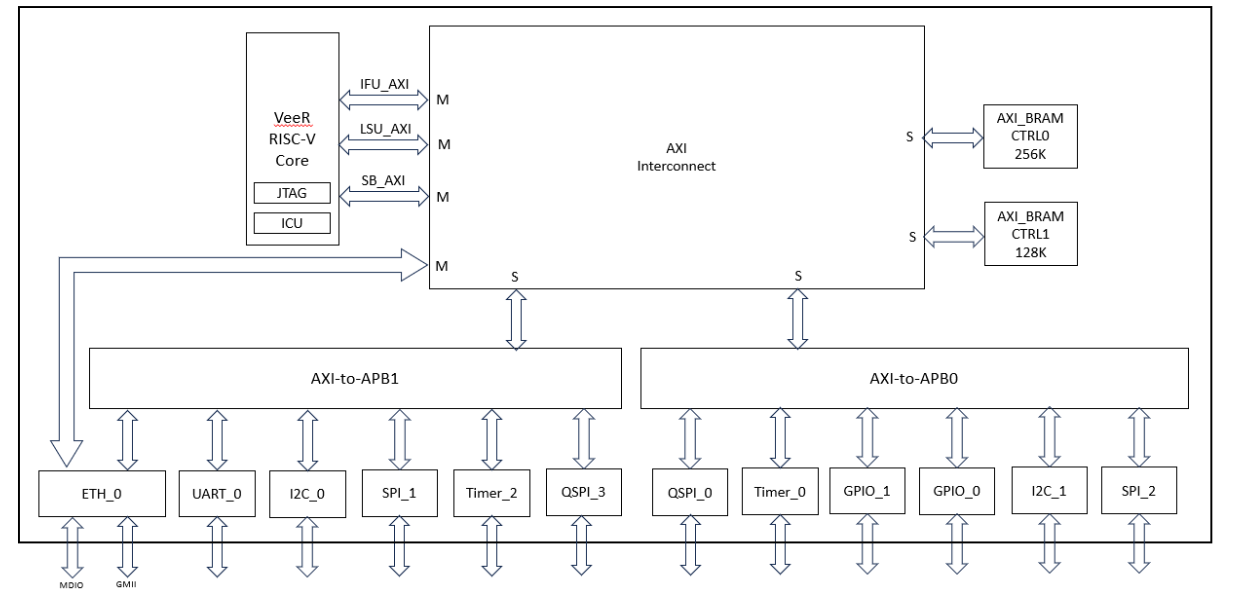
Universa U1 - Hardware Diagram
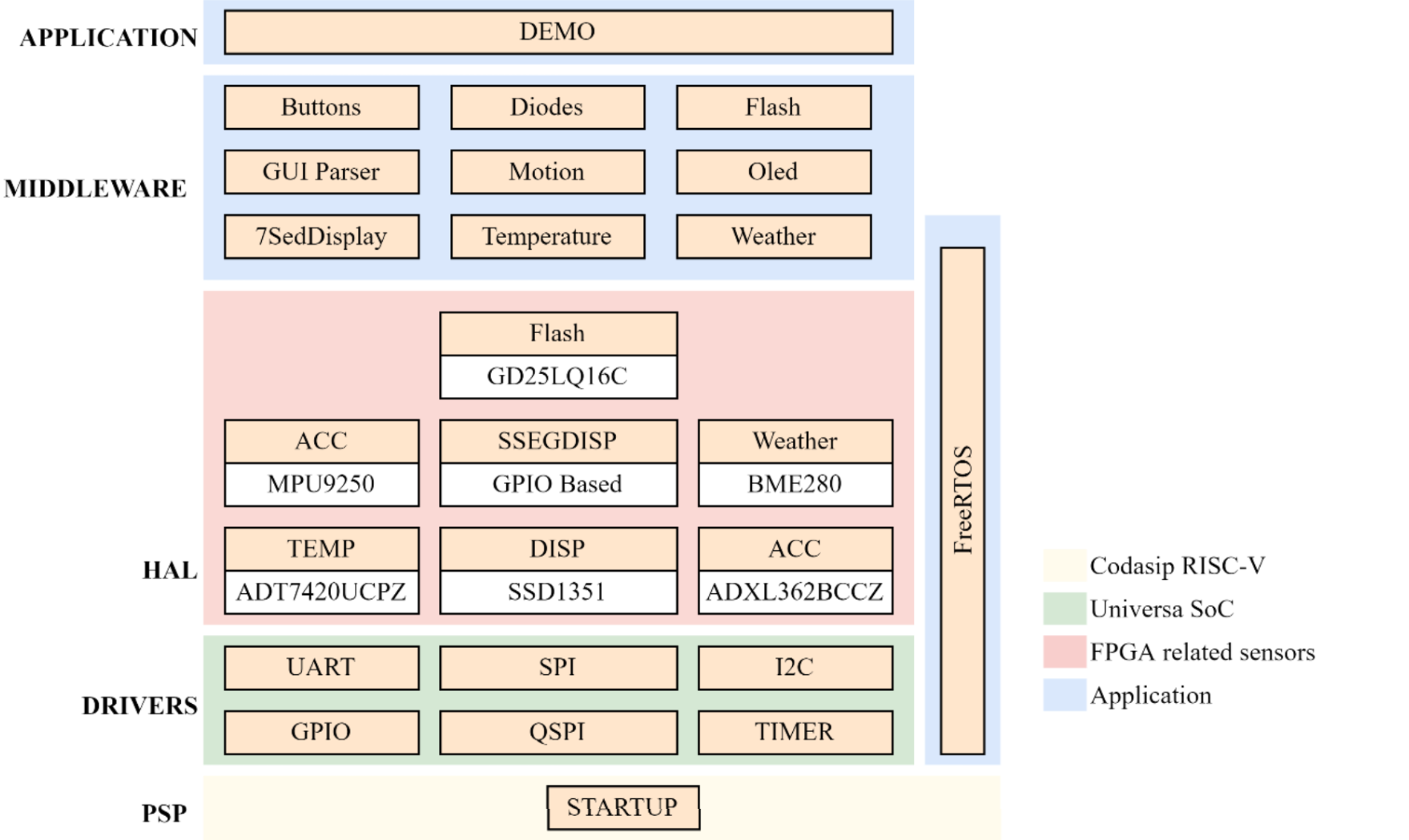
Universa U1 - Software Diagram
Frequently Asked Questions about Soft IPs
Soft IP cores are reusable, flexible building blocks used in semiconductor and SoC design. They allow engineers to accelerate development by integrating proven components into new chip architectures.
What is a soft IP core?

A soft IPcore is a reusable hardware design provided in a synthesizable format (usually RTL). It can be customized and integrated into different chip designs, making it flexible for various semiconductor and SoC applications.
What is an IP core in semiconductor design?
An IP core is a pre-designed, reusable block of logic used in chip design. IP cores can include processors, interfaces, or memory controllers, and are commonly integrated into SoC IP cores to accelerate development and reduce design complexity.
What is the difference between soft IP and hard IP?
A soft IPcore is delivered as RTL code and can be modified, while hard IP is provided as a fixed physical layout optimized for performance and power. SoftIP offers flexibility, where as hard IP provides higher efficiency and predictability.
How are IP cores used in SoC design?
SoC IP cores are integrated as building blocks within a System-on-Chip. Designers combine multiple IP cores—such as CPUs, communication interfaces, and accelerators—to create complex semiconductor systems more efficiently.
Why are soft IP cores important in modern chip design?
Soft IP cores enable faster development by allowing reuse, customization, and easier integration into different designs. They reduce time-to-market and are widely used in scalable semiconductor and SoC development workflows.